Best apply process for mobile recruitment applications
Nicole Clarke • June 15, 2026
Mobile is now the primary channel for job applications, yet many recruitment systems are still designed for desktop workflows.
This creates a major gap in candidate experience.
1. Mobile candidates expect speed
Mobile users are typically:
- On-the-go
- Multi-tasking
- Low patience for long forms
If the process is slow, they abandon immediately.
2. Forms are often not mobile-optimised
Common issues include:
- Small input fields
- Excessive scrolling
- Multi-page forms that lose progress
3. Upload friction reduces completion
CV uploads, login requirements, and manual data entry are major drop-off points on mobile.
4. External ATS pages damage mobile experience
Redirecting candidates to external systems often breaks:
- Branding consistency
- Page speed
- Application flow continuity
5. What a strong mobile apply process looks like
Best-performing systems:
- Allow quick apply options
- Use autofill and CV parsing
- Keep candidates in a single mobile-friendly flow
- Minimise typing requirements
Mobile apply optimisation is no longer optional. It directly impacts application volume, candidate quality, and conversion rates.
Why this matters for recruitment and staffing agencies
Recruitment is a trust business.
Employers do not just want a supplier. They want confidence.
Candidates do not just want another job ad. They want relevance, clarity and a reason to engage.
An AI-ready recruitment website helps both sides of the market.
For employers, it should show your sector expertise, case studies, hiring insights, salary knowledge, consultant credibility and ability to solve hard hiring problems.
For candidates, it should make it easy to search jobs, apply, register, set up job alerts, understand your market expertise and trust your consultants.
For AI and search engines, it should provide clear signals about your agency’s specialisms, services, locations, jobs, content and proof.
That is the sweet spot.
Human-friendly.
Search-friendly.
AI-friendly.
Conversion-friendly.
That is what modern recruitment websites need to be.
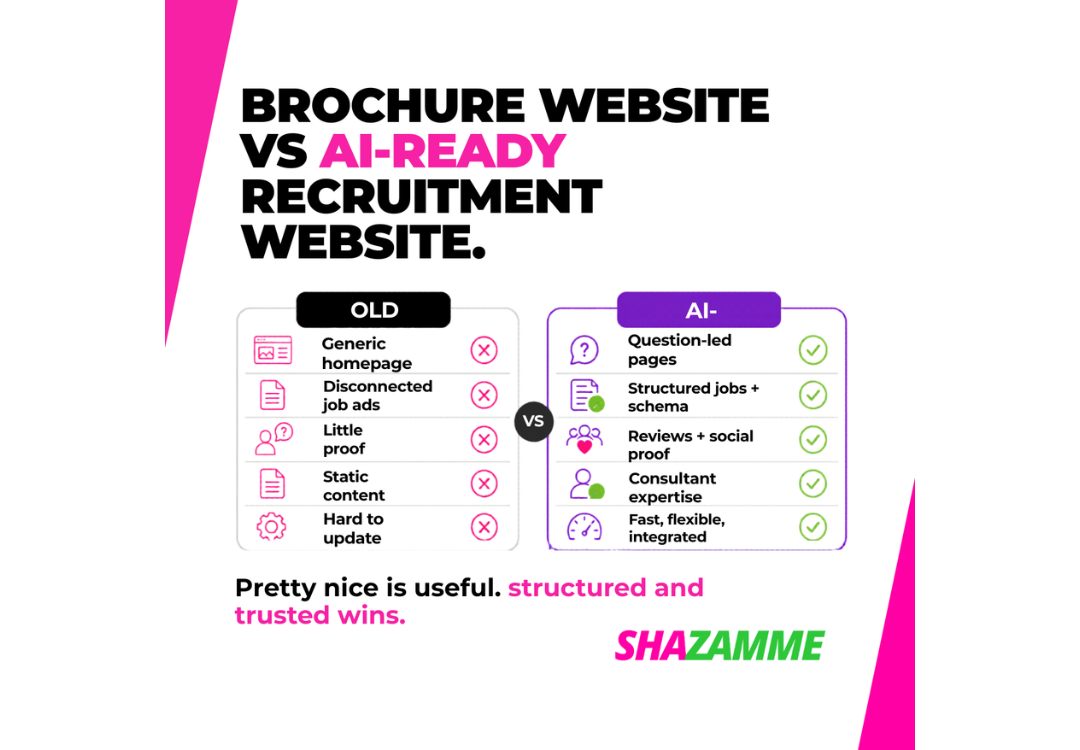
Brochure website vs AI-ready recruitment website
Most underperforming recruitment websites are not broken because they look bad.
They are broken because they are too thin.
Here is the difference.
Brochure recruitment website AI-ready recruitment website
Generic homepage Clear sector, service and location pages
Jobs pushed through a basic feed Structured jobs with schema and SEO value
Weak consultant profiles Consultant expertise pages with market authority
Blogs posted randomly Question-led content hubs built around search intent
Little proof Reviews, case studies, results and trust signals
Disconnected ATS experience Deep ATS integration and branded candidate journeys
Hard to update Flexible no-code editing for fast campaign pages
Built mainly for humans Built for humans, search engines and AI systems
A brochure website says, “Here we are.”
An AI-ready recruitment website says, “Here is exactly who we help, what we know, where we operate, what proof we have and why we should be trusted.”
That second version is far more useful to employers, candidates and AI.
What AI needs to recommend your recruitment agency
AI does not guess well when your website is vague.
It needs clear signals.
1. Clear industry and sector pages
If your agency specialises in healthcare, technology, construction, finance, legal, executive search, industrial, education or any other niche, your website needs dedicated pages that explain that expertise.
Not one vague “Industries” page.
Proper pages.
Each page should explain the roles you recruit for, the employers you support, the candidate market, location relevance, salary trends, hiring challenges and why your agency is credible in that space.
This helps Google and AI understand your specialisms.
It also helps employers feel like they have found the right agency.
That part matters. A lot.
2. Location relevance
Recruitment is often local, regional, national and global at the same time.
Your website needs to help search engines and AI understand where you operate.
If you recruit in Melbourne, Sydney, Brisbane, London, Manchester, New York, Singapore or across multiple regions, those signals need to be clear.
Location-rich content can include:
Location pages
Local hiring guides
Regional salary insights
Consultant profiles by region
Jobs by location
Employer advice by market
Candidate guides for specific areas
AI should not have to guess where you recruit.
Make it obvious.
3. Structured job ads with job schema
Your jobs are not just vacancies.
They are data assets.
Every job helps search engines and AI understand the roles, sectors, salaries and locations your agency works with.
But only if those jobs are structured properly.
A high-performing recruitment job page should include:
Clear job title
Location
Salary where possible
Employment type
Job description
Benefits
Application instructions
Recruiter or consultant details
Relevant internal links
Job schema
Clean URL structure
Mobile-friendly apply flow
Google’s job search documentation recommends structured job posting data to help eligible job pages appear in richer job search experiences. For recruitment agencies, this is not a “nice extra”. It is foundational. (blog.google)
And no, dumping jobs onto a disconnected subdomain with a clunky apply journey is not a conversion strategy.
It is a candidate leak.
4. Reviews and social proof
AI and buyers both look for proof.
Your website should showcase:
Google reviews
Candidate testimonials
Client testimonials
Case studies
Awards
Partnerships
Success stories
Consultant credibility
Media mentions
Market authority
It is not enough to say you are good.
Everyone says that.
Some say they are “market-leading”, which is often marketing code for “we needed a headline”.
Proof wins.
5. Consultant expertise
Recruiters are no longer just recruiters.
They are expert signals.
A strong consultant profile should do more than show a headshot and a phone number.
It should show:
Specialist markets
Location coverage
Roles recruited
Candidate and client focus
Insights and articles
LinkedIn activity
Reviews or testimonials
Jobs managed by that consultant
Ways to contact or book a conversation
This helps candidates know who they are dealing with.
It helps employers see your market depth.
It gives AI more context about your people and expertise.
6. Question-led content
Search and AI are increasingly question-led.
People ask:
What is the best recruitment agency for healthcare roles?
How do I attract passive candidates?
What salary should I offer for this role?
How do I improve candidate experience?
How do recruitment agencies find hard-to-reach talent?
What makes a recruitment website convert?
How do I choose a staffing agency?
Your website should answer these questions clearly.
The best recruitment websites are becoming learning hubs, not just job boards.
That does not mean writing endless blogs for the sake of it.
It means creating useful, structured content that directly answers what employers and candidates are already searching for.

Social content now affects recruitment visibility
SEO no longer lives only on your website.
LinkedIn posts, videos, podcasts, newsletters, PR, reviews, social conversations and third-party mentions all shape how your agency is understood online.
That matters because B2B buyers use social proof before making decisions. LinkedIn has reported that around 75% of B2B buyers use social media to help make purchasing decisions, and 76% say thought leadership shapes which vendors they shortlist. (LinkedIn)
For recruitment agencies, this is huge.
Your consultants’ LinkedIn content can support your agency visibility.
Your videos can support search discovery.
Your insights can build trust before a sales conversation ever happens.
Your reviews can reinforce credibility.
Your website should not sit separately from this activity.
It should connect everything.
That is how visibility compounds.
Candidate experience is part of website performance
A recruitment website can rank well and still fail if the candidate experience is poor.
This is where many agencies quietly lose revenue.
A candidate finds the job.
They click apply.
They hit a clunky form.
They get redirected to a poor ATS experience.
They give up.
No complaint.
No email.
No dramatic exit.
Just gone.
Recruitee’s 2025 hiring insights reported that 41.2% of applications were abandoned halfway through, a reminder that candidate friction is still a major conversion issue. (recruitee.com)
For recruitment agencies, that is painful.
You work hard to attract candidates. You pay for marketing. You invest in job ads. You build a brand. Then poor technology loses people at the point of action.
An AI-ready recruitment website should also be a conversion-ready recruitment website.
That means:
Fast job search
Simple apply flows
Mobile-first design
Branded application journeys
Job alerts
Candidate registration
Clear consultant contact options
Useful job recommendations
Employer enquiry forms
Landing pages for campaigns
ATS integration that feels seamless
Candidate experience is not a fluffy brand issue.
It is a revenue issue.
Why ATS integration is critical
A recruitment website is only as powerful as the systems behind it.
If your website, job board, CRM, ATS, forms, landing pages, marketing workflows and analytics are disconnected, your team ends up doing too much manual work and your data becomes messy.
That is why deep ATS integration matters.
A modern recruitment website platform should connect with systems such as Bullhorn, JobAdder, Vincere and other recruitment ATS platforms in a way that supports both candidate experience and business performance.
With Shazamme, this is powered by StackSync, our advanced recruitment integration layer.
StackSync helps connect your recruitment website, jobs, forms, candidate journeys, marketing activity and data flows so your website does more than look good.
It works harder.
A properly integrated recruitment website can support:
Live job feeds
Custom job boards
Field mapping
Custom forms
Screening questions
Referral forms
Employer enquiry forms
Candidate portals
Job alerts
Source tracking
Marketing campaigns
Analytics and conversion tracking
Multi-brand recruitment websites
Recruitment automation workflows
This is where recruitment websites move from “online brochure” to business growth engine.

How Shazamme helps recruitment agencies become AI-ready
Shazamme builds recruitment websites and career sites designed for the way recruitment now works.
That means your website is built to support:
SEO visibility
AI search visibility
Answer Engine Optimisation
Recruitment job schema
ATS integration
Employer conversion
Candidate conversion
Landing pages
Job boards
Consultant profiles
Reviews and proof
Content hubs
Salary guides
Campaign pages
Multi-brand recruitment groups
Data and analytics
Fast no-code updates
Secure, scalable performance
Our platform is designed specifically for recruitment and staffing agencies, not retrofitted from generic website software.
That matters.
Recruitment websites are not normal websites.
They need jobs.
They need ATS integrations.
They need candidate flows.
They need employer journeys.
They need SEO structure.
They need schema.
They need content flexibility.
They need speed.
They need security.
They need data.
They need to change quickly.
A generic website platform can make something look nice.
A recruitment website platform needs to make it perform.
That is the difference.
The must-have features of an AI-ready recruitment website
If you are reviewing your current recruitment website, here is the checklist.
Strategy and structure
Clear homepage positioning
Dedicated sector pages
Dedicated service pages
Location pages
Employer and candidate journeys
Strong internal linking
Question-led content
FAQs on key pages
Clear calls to action
Conversion-focused page layouts
Job board and candidate experience
Branded job board
Structured job pages
Job schema
Clean job URLs
Search and filters
Job alerts
Mobile-first apply flow
Candidate registration
Consultant details on job pages
Related jobs and content
Fast application experience
ATS and integrations
Live ATS job feed
Custom field mapping
Screening questions
Referral forms
Employer enquiry forms
Candidate forms
Source tracking
CRM and marketing integration
Multi-brand support
Analytics and reporting
Trust and authority
Reviews
Testimonials
Case studies
Consultant profiles
Market insights
Salary guides
Video content
Thought leadership
Awards and partnerships
PR and media mentions
AI and search readiness
Structured content
Schema markup
Entity clarity
Author and consultant signals
Fresh content updates
Question-based headings
Clear answer blocks
Location and sector relevance
Strong metadata
Useful internal links
Content that answers real questions
If your website is missing many of these, it is not just a design issue.
It is a visibility and conversion issue.
The commercial upside of getting this right
An AI-ready recruitment website can help your agency:
Increase employer enquiries
Improve candidate conversion
Reduce reliance on job boards
Improve Google visibility
Increase AI search visibility
Build stronger consultant authority
Improve brand trust
Make job ads work harder
Create better campaign landing pages
Improve reporting and attribution
Support business development
Turn your website into a proper growth channel
This is what recruitment agencies should expect from their website.
Not just “it looks modern”.
That is the lowest bar.
A recruitment website should help you attract employers, engage candidates, support consultants and create measurable revenue opportunities.
If it does not, it needs work.
Common signs your recruitment website is not AI-ready
Your website may need attention if:
Your jobs sit on a disconnected third-party experience
Your job pages do not use proper job schema
Your sector pages are thin or missing
Your location signals are weak
Your consultant profiles are basic
Your blogs are random and not question-led
Your website is hard to update
Your ATS integration is limited
Your forms do not map properly into your ATS
Your application process is clunky
You cannot track conversions properly
You rely heavily on paid job ads
Your website does not generate employer enquiries
Your content does not answer buyer questions
Your agency does not appear in AI search results
If you nodded more than twice, your website is probably not doing enough.
No judgement. But let’s not pretend it is fine.
AI-ready does not mean robotic
This is important.
Being AI-ready does not mean writing boring content for machines.
It means creating clearer, better structured, more useful content for everyone.
Humans want clarity too.
Employers want quick answers.
Candidates want relevant jobs.
Consultants want less manual work.
Google wants structure.
AI wants context.
Good recruitment website strategy serves all of them.
The best AI-ready websites still feel human. They just give machines enough structure to understand why the human should care.
That is the balance.
Should recruitment agencies rebuild or optimise their current website?
It depends.
Some recruitment websites can be improved with better structure, stronger content, schema, landing pages and improved conversion paths.
Others need a proper rebuild because the technology underneath is holding them back.
You may need a new recruitment website if:
You cannot update pages quickly
Your ATS integration is limited or unreliable
Your job board is poor
Your website is slow or hard to manage
Your candidate journey is clunky
Your SEO structure is weak
Your site cannot support multiple brands or locations
Your forms and workflows are disconnected
Your team relies on developers for basic changes
Your website does not support modern AI, SEO and AEO requirements
A website rebuild should not just be a visual refresh.
It should be a commercial reset.
The question is not, “Can we make it look better?”
The better question is, “Can we make it generate more visibility, trust, enquiries and applications?”
That is the only website conversation worth having.
Final thought: your recruitment website has a bigger job now
Recruitment websites have changed.
They are no longer just places people visit.
They are signals.
They are data sources.
They are conversion engines.
They are trust builders.
They are content hubs.
They are job distribution assets.
They are AI training material.
That means recruitment agencies need to stop treating websites like digital brochures.
The agencies that win over the next few years will be the ones that build websites designed for how employers, candidates, search engines and AI actually make decisions.
That means clearer structure.
Better content.
Stronger integrations.
More proof.
Smarter job pages.
Better candidate experience.
More useful thought leadership.
More measurable conversion paths.
And much less fluffy nonsense.
If your recruitment website is not helping AI, search engines, employers and candidates understand why your agency should be trusted, it is not doing its job.
At Shazamme, we help recruitment and staffing agencies build AI-ready recruitment websites, job boards, landing pages and integrated marketing ecosystems designed to attract employers, engage candidates and drive real business outcomes.
If your website still feels like a brochure, it might be time to turn it into something much more useful.

Want to know if your recruitment website is AI-ready?
Book a recruitment website health check with Shazamme.
We will review your website structure, job board, ATS integration, SEO foundations, AI search readiness, candidate journey and conversion opportunities.
No fluff.
No scary jargon.
Just clear advice on what is working, what is holding you back and what to fix next.
Book a demo or website health check with Shazamme.
FAQs
What is an AI-ready recruitment website?
An AI-ready recruitment website is a website built so humans, search engines and AI platforms can clearly understand your agency. It includes structured jobs, job schema, sector pages, location signals, consultant expertise, FAQs, reviews, useful content and strong ATS integrations.
Why do recruitment agencies need AI-ready websites?
Recruitment agencies need AI-ready websites because employers and candidates increasingly use AI tools and AI-powered search results to compare options. If your website is not structured clearly, AI may not understand or recommend your agency.
What makes a recruitment website rank better in Google and AI search?
A recruitment website is more likely to perform well when it has clear sector pages, location relevance, structured job ads, job schema, useful FAQs, strong internal linking, consultant expertise, reviews, fast performance and content that answers real employer and candidate questions.
Are job ads important for recruitment website SEO?
Yes. Job ads are valuable SEO and AI signals when they are structured properly. Each job can help search engines understand the roles, locations, industries and salaries your agency works with. Job schema, clean URLs and strong job content are essential.
What is job schema for recruitment websites?
Job schema is structured data added to job pages to help search engines understand job details such as title, location, salary, employment type, company, description and application details. It can improve how eligible jobs appear in search results.
Why is ATS integration important for recruitment websites?
ATS integration is important because it connects your website, job board, application forms, candidate data and recruiter workflows. A strong ATS integration reduces manual work, improves candidate experience and helps recruitment agencies track performance more effectively.
Can a recruitment website generate more employer enquiries?
Yes. A recruitment website can generate more employer enquiries when it has clear employer journeys, strong sector pages, proof, case studies, consultant expertise, conversion-focused landing pages, useful hiring content and easy enquiry forms.
What is the difference between a recruitment website and a recruitment website platform?
A recruitment website is the front-end site people see. A recruitment website platform includes the technology behind it, such as job boards, ATS integrations, page editing, forms, landing pages, SEO tools, schema, analytics and marketing features.
Is Shazamme suitable for large recruitment agencies?
Yes. Shazamme supports recruitment agencies from start-ups to large enterprise and multi-brand recruitment groups. The platform is designed for complex recruitment website requirements, advanced ATS integrations, multiple job boards, campaign pages and scalable marketing activity.
How do I know if my recruitment website is underperforming?
Your recruitment website may be underperforming if it does not generate employer enquiries, has low candidate conversion, uses disconnected job pages, lacks job schema, has weak sector content, is hard to update or does not appear in relevant search and AI results.
Share this article
Latest articles