How LinkedIn Content Helps Recruitment Agencies Get Found in AI Search
Nicole Clarke • July 14, 2026
Recruitment and staffing agencies can improve their visibility in AI search by publishing clear, expert-led LinkedIn content about the roles, industries, locations, salaries and hiring decisions they genuinely understand.
The strongest approach combines:
- Expert content from individual recruiters
- Original agency data
- Clear answers to employer and candidate questions
- Detailed website resources
- Relevant sector and location pages
- Current jobs
- Strong authorship and third-party proof
There is no guaranteed method for making ChatGPT, Google AI Mode, Copilot, Gemini or another platform recommend a recruitment agency.
But agencies can make their expertise easier to find, understand, verify and cite.
Why LinkedIn matters to AI search
Meltwater analysed 9.5 million AI citations across six major AI platforms to understand which sources appeared in generated answers.
LinkedIn ranked as the second most-cited source overall, behind YouTube. Its citation share increased by 26% over the four-week study, and it ranked among the five most-cited sources across 14 business categories. For HR and Talent questions, LinkedIn ranked third. (LinkedIn)
That is particularly relevant to recruitment and staffing agencies.
LinkedIn contains public information from recruiters, consultants, employers, candidates, industry specialists and company pages.
Those people regularly publish information about:
- Employment markets
- Salary movements
- Hiring challenges
- Candidate behaviour
- Industry trends
- Skills shortages
- Career decisions
- Workplace expectations
When AI platforms answer professional or hiring-related questions, LinkedIn is one of the sources they may use.
What does this mean for recruitment agencies?
It means LinkedIn is no longer only a social distribution channel.
The expertise your people publish may also influence how your agency, industry and market are represented in AI-generated answers.
An employer may ask:
- Who are the best construction recruitment agencies in Melbourne?
- Which staffing companies specialise in healthcare recruitment in California?
- What should a financial controller earn in Manchester?
- Should I use retained search for a chief executive appointment?
- Why are candidates withdrawing after final interview?
- How should I compare recruitment agencies?
A candidate may ask:
- Which recruiters specialise in legal roles in Dublin?
- What is the average salary for a project manager in Toronto?
- Should I accept a counteroffer?
- Is contracting better than permanent employment?
- How can I choose a trustworthy recruiter?
An AI answer may include information from an agency website, a recruiter’s LinkedIn article, reviews, industry publications or other third-party sources.
If your agency is not publishing useful information, another source may define the answer instead.
Individual recruiters are generating most LinkedIn citations
Meltwater found that 75% of LinkedIn citations came from individual member profiles, while 25% came from company pages.
It also found that 51% of cited creators had fewer than 10,000 followers. (LinkedIn)
This gives smaller and specialist recruitment agencies a genuine opportunity.
Visibility is not reserved for the largest firms or the biggest personal brands.
A specialist recruiter who regularly publishes useful information about engineering recruitment in Texas may be more relevant to a specific question than a global agency publishing broad commentary about the future of work.
Company pages still matter.
The strongest strategy is to combine a credible company presence with a group of visible specialists who each own clearly defined subjects.
For example:
- A healthcare recruiter owns regional nursing recruitment
- A technology recruiter owns cybersecurity hiring
- A finance consultant owns commercial accounting salaries
- A construction recruiter owns infrastructure hiring
- An executive search leader owns board and C-suite appointments
This creates depth across the agency rather than placing all responsibility on one founder or marketing manager.
What highly cited LinkedIn content has in common
Meltwater separately examined the 24 most-cited LinkedIn articles in the study.
It found the following structural characteristics:
- Bulleted or numbered lists: 100%
- Clear headings: 92%
- Named companies, tools or other entities: 75%
- Hard numbers or data: 67%
- Comparison or evaluation frameworks: 50%
- How-to-choose guidance: 33%
- The year included in the title: 25% (Meltwater)
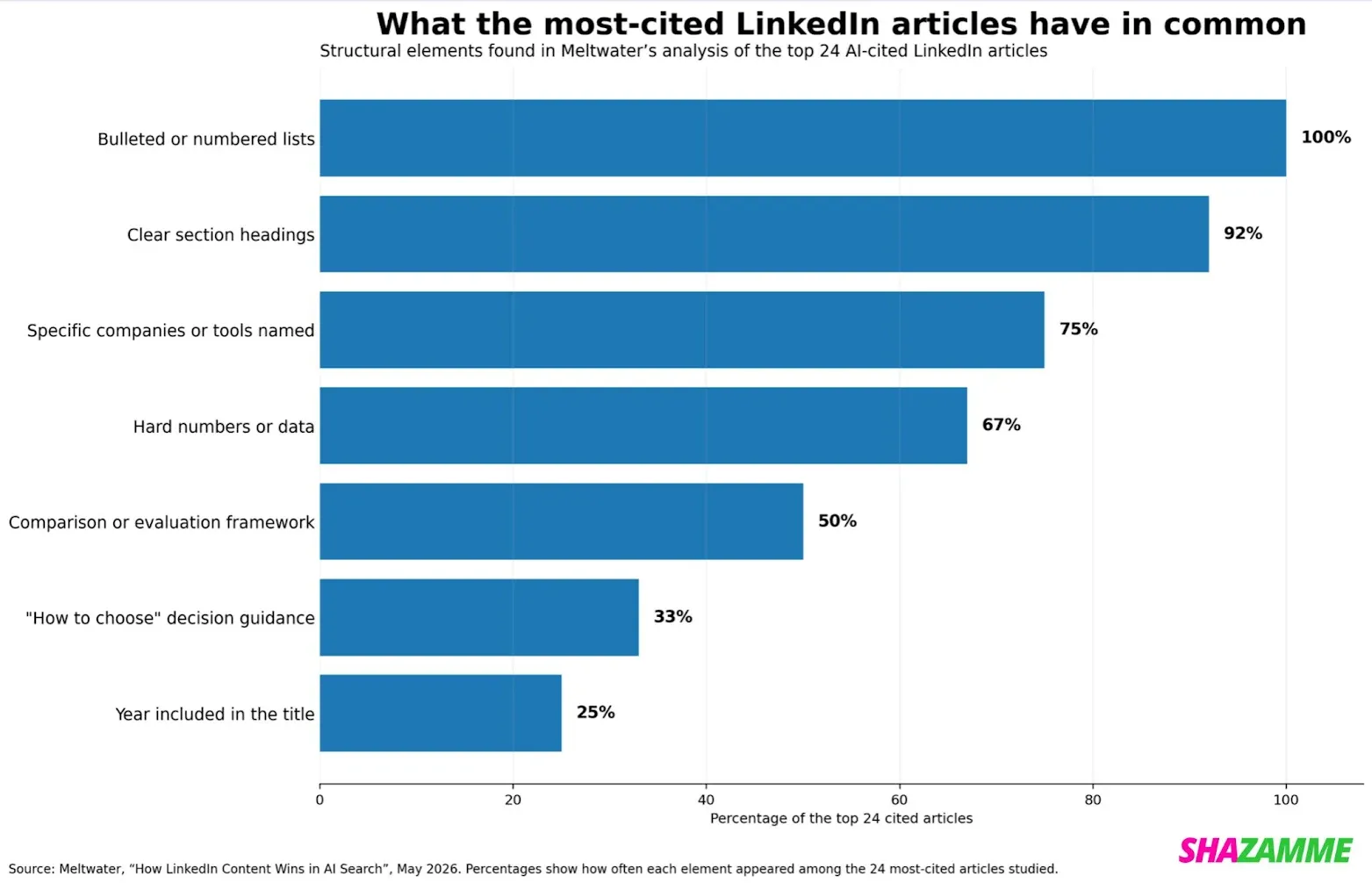
These figures describe a sample of only 24 articles. They show correlation, not a guaranteed method for earning citations.
The lesson is not that every article must follow an identical template.
The lesson is that direct, organised and evidence-backed content is easier to understand and reuse than vague opinion.
What “named entities” means for recruitment content
The original research refers to content naming specific companies, tools and other entities.
For recruitment agencies, this principle needs to be applied to the subjects their clients and candidates care about.
Be specific about:
- Job titles
- Industries
- Locations
- Qualifications
- Seniority levels
- Salary ranges
- Contract types
- Hiring models
- Candidate groups
- Employer challenges
For example:
Broad topic:
Healthcare recruitment trends
Better topic:
Why registered nurses are withdrawing from regional Queensland hiring processes
Broad topic:
Technology salary update
Better topic:
Senior cybersecurity salaries in London in 2026
Broad topic:
Choosing a recruitment agency
Better topic:
Retained versus contingent recruitment for a senior finance appointment
Specific information gives the reader immediate context.
It also makes it clearer which questions the content may answer.
Seven ways recruitment agencies can create stronger LinkedIn content
1. Start with real employer and candidate questions
Do not begin with a need to “post something on LinkedIn.”
Begin with a question your market genuinely needs answered.
Speak with recruiters, account managers, resourcers, delivery teams and business development staff.
Look for questions such as:
- What salary should we offer?
- Why are candidates rejecting us?
- How long should this role take to fill?
- Should we use a contractor?
- When is retained search appropriate?
- What skills are genuinely essential?
- Should I accept a counteroffer?
- How do I compare two offers?
- What should I ask a recruiter?
- Can I move into this industry?
A good LinkedIn article should answer one substantial question properly rather than touching lightly on ten unrelated subjects.
2. Put the answer near the top
Do not force readers through several paragraphs about the changing world of work before reaching the useful point.
Start with a direct answer.
For example:
Employers hiring senior cybersecurity professionals in London should expect salary expectations to vary significantly according to security clearance, industry experience and team leadership responsibilities.
Then explain the evidence, differences and practical implications.
This helps busy readers and gives the article a clear focus.
3. Use first-hand recruitment knowledge
Your agency sees things other publishers do not.
Useful subjects may include:
- Salary changes based on placements
- Candidate supply by location
- Roles taking longest to fill
- Offer acceptance rates
- Reasons candidates withdraw
- Skills appearing in job briefs
- Interview processes causing delays
- Differences between contract and permanent hiring
- Regional recruitment conditions
- Candidate expectations by seniority
Be transparent about the evidence.
Instead of:
Our data shows salaries are increasing.
Write:
This review is based on 240 accounting placements completed across Sydney and Melbourne between July 2025 and June 2026.
The second version gives the reader enough information to judge the relevance of the finding.
4. Create decision content
Meltwater found that best-of lists appeared in 54% of the most-cited content formats it examined, side-by-side comparisons in 50% and how-to-choose guides in 33%. Pure opinion was less prominent unless supported by evidence. (Meltwater)
Recruitment agencies can apply this through topics such as:
- Retained versus contingent recruitment
- Permanent employees versus contractors
- Exclusive versus non-exclusive recruitment
- Specialist agencies versus generalist agencies
- Internal recruitment versus agency support
- Remote versus hybrid roles
- Accepting versus declining a counteroffer
- Contracting versus permanent employment
- Salary versus career progression
- Local versus international candidate sourcing
A credible comparison should explain the benefits, limitations and situations where each choice makes sense.
Do not pretend one answer suits everyone.
That is not guidance. It is a sales pitch with a heading.
5. Attach content to genuine specialists
Important content should have a credible person behind it.
A consultant profile should clearly show:
- Full name
- Job title
- Area of recruitment expertise
- Industries covered
- Locations covered
- Relevant experience
- Other content they have published
- A professional LinkedIn profile
A salary guide written by an experienced specialist carries more context than content published by an anonymous company account.
Marketing can interview the expert, improve the structure and polish the writing.
The final piece should still sound like someone who understands recruitment, not a committee trying not to offend anybody.
6. Keep content current and original
Meltwater found that 72% of cited LinkedIn content was original rather than reshared. Forty-eight per cent had been published within the previous three months, while only 12% was more than one year old. (LinkedIn)
Review content containing:
- Salary figures
- Contract rates
- Employment legislation
- Visa information
- Candidate demand
- Skills shortages
- Market conditions
- Job-search advice
- Hiring expectations
Do not simply change the date.
Make a meaningful update and explain what has changed.
7. Use writing as the foundation
Written posts accounted for 72% of cited LinkedIn content, articles 12% and video 11%. Together, written posts and articles represented 83% of cited content in the study. (Meltwater)
Video is still valuable for reach, trust and personality.
But a video should be supported by clear written information.
A strong workflow could include:
- Publish a detailed website guide.
- Create a personal LinkedIn newsletter.
- Turn the strongest insights into shorter posts.
- Record a direct-to-camera video.
- Create a chart or checklist.
- Link each format to a useful next step.
One strong idea can become several useful formats without becoming repetitive filler
How LinkedIn content should connect to the recruitment website
LinkedIn helps demonstrate the expertise of your people.
Your website should provide the more complete, permanent version.
A strong website resource can include:
- The detailed answer
- Original salary or market data
- Current jobs
- Relevant industry pages
- Location-specific information
- Consultant profiles
- Employer and candidate FAQs
- Case studies
- Related articles
- A clear enquiry or registration pathway
For example, a LinkedIn article about construction project manager salaries in Brisbane should link to a website resource containing:
- Detailed salary ranges
- The factors affecting pay
- Current Brisbane construction jobs
- The construction recruitment team
- Advice for employers
- Advice for candidates
- Related construction and Brisbane pages
This creates a connected subject rather than an isolated post.
How to optimise the website version for SEO and AI search
Google says the same foundational SEO practices remain relevant for its generative features, including AI Overviews and AI Mode. Pages must be indexable and eligible to appear in normal Search, and there is no special AI schema or separate technical shortcut required. (Google for Developers)
Use a clear page title and URL
The title should explain the subject, audience and purpose.
For example:
Senior Cybersecurity Salaries in London: 2026 Recruitment Guide
A useful URL could be:
/cybersecurity-salaries-london
Avoid URLs filled with meaningless numbers or platform-generated codes.
Give the direct answer early
Include a concise answer within the introduction, then provide the evidence and detail underneath.
This supports people looking for a quick response without weakening the deeper article.
Use clear section headings
Headings should match the questions readers ask.
For example:
- What is the average cybersecurity salary in London?
- Which skills attract the highest salaries?
- How do contract rates compare?
- What should employers offer?
- What should candidates negotiate?
Add relevant internal links
Connect the article to:
- The relevant sector page
- The location page
- Current jobs
- Consultant profiles
- Salary guides
- Employer services
- Candidate resources
- Related market updates
Internal links help people move through the subject and help search platforms discover related pages.
Include visible author information
Show who wrote or reviewed the article and why that person is qualified to comment.
Do not publish expert content under “Admin.”
Admin has made surprisingly few placements.
Use structured data accurately
Relevant structured data may include:
- Article
- Person
- Organization
- EmploymentAgency
- LocalBusiness
- BreadcrumbList
- JobPosting
- FAQPage where appropriate
Structured data helps Google understand page content, but it must accurately match what is visible on the page. It does not guarantee a special search result or an AI citation. (Google for Developers)
Individual job pages should use accurate JobPosting structured data and include visible information such as job title, location, employment type, date posted and application details. (Google for Developers)
Include genuine location relevance
For location-specific recruitment content, include information that is genuinely local:
- Roles in demand
- Local salary ranges
- Industries hiring
- Regional candidate conditions
- Current jobs
- Consultants covering the area
- Nearby locations served
- Relevant client or candidate questions
Do not create hundreds of copied pages and change only the city name.
That does not demonstrate local expertise. It demonstrates access to find and replace.
Add useful questions and answers
A visible FAQ section can answer related employer and candidate questions directly.
For example:
- What is the average salary for this role?
- How long does the hiring process take?
- Are contract rates increasing?
- Which qualifications are most valuable?
- Is this market candidate-short?
- How can employers improve acceptance rates?
Only include questions that are genuinely relevant to the page.
Recruitment content ideas that suit LinkedIn and AI search
Salary and market content
- Senior finance salaries in Toronto
- Construction contract rates in Melbourne
- Technology salaries in Berlin
- Healthcare hiring conditions in Texas
- Legal recruitment trends in Dublin
- Engineering talent shortages in Manchester
Employer decision content
- Retained versus contingent recruitment
- When to use an executive search firm
- Contractor versus permanent employee
- How to compare recruitment agency fees
- How many interview stages are too many?
- Why candidates reject job offers
- How to recruit in a difficult location
Candidate decision content
- Should you accept a counteroffer?
- How to compare two job offers
- Contracting versus permanent employment
- What salary should you request?
- How to choose a trustworthy recruiter
- Which qualifications improve job prospects?
- How to move into a new industry
Local recruitment content
- Hiring accountants in Sydney
- Recruiting nurses in regional Australia
- Finding cybersecurity talent in London
- Hiring construction professionals in Dallas
- Recruiting lawyers in Dublin
- Technology recruitment in Singapore
How to measure LinkedIn and AI-search visibility
Do not rely on LinkedIn reactions alone.
A post may generate limited public engagement while still influencing a prospect, search result or AI-generated answer.
Measure LinkedIn performance
Track:
- Article views
- Post views
- Profile views
- Follower growth among relevant audiences
- Saves
- Shares
- Comments from employers and candidates
- Website visits
- Enquiries connected to content
Measure AI visibility
Create a consistent list of commercially relevant questions, such as:
- Best recruitment agency for [industry] in [location]
- Recruitment agencies specialising in [role]
- Average salary for [role] in [location]
- How to hire [role]
- How to choose a recruitment agency
- Retained versus contingent recruitment
Record:
- Whether your agency appears
- Whether your consultants appear
- Which competitors appear
- Which sources are cited
- Which pages are referenced
- How results differ between platforms
- How visibility changes over time
One prompt on one day proves very little.
Look for patterns.
Measure commercial impact
Connect content to:
- Employer enquiries
- Candidate registrations
- Job applications
- Meetings booked
- New opportunities
- Lead velocity
- Placements
- Revenue
- Source-to-placement return
Use UTMs, website analytics, CRM information and ATS outcomes wherever possible.
Traffic is useful.
Placements are considerably more exciting.
Frequently asked questions
Can LinkedIn content help a recruitment agency appear in AI search?
Yes, it can contribute. Meltwater’s study found LinkedIn was the second most-cited source overall across the AI platforms analysed, and LinkedIn ranked highly for HR and Talent questions. Inclusion is never guaranteed, and LinkedIn should be part of a wider strategy that also includes the agency website, expert authorship, reviews and third-party evidence. (LinkedIn)
Should recruiters publish from personal profiles or the company page?
Use both, but prioritise genuine experts. Individual profiles accounted for 75% of LinkedIn citations in Meltwater’s study, compared with 25% for company pages. (LinkedIn)
What should recruitment consultants write about on LinkedIn?
They should write about the markets they genuinely understand, including salaries, hiring difficulties, candidate behaviour, interview processes, role requirements, local employment conditions and career decisions.
Do recruiters need thousands of followers to be cited?
No. Meltwater reported that 51% of cited creators had fewer than 10,000 followers. Relevance, expertise and clear content mattered more than having an enormous audience. (Meltwater)
Should the LinkedIn and website articles be identical?
No. The subject and evidence can be shared, but each version should suit its platform.
The LinkedIn version should be more personal, opinionated and concise.
The website version should provide greater depth, stronger internal linking, structured questions, original data and clear conversion pathways.
Does a recruitment website need special AI schema?
No. Google says there is no special schema required for AI Overviews or AI Mode. Existing SEO, technical accessibility and helpful content remain the foundation. (Google for Developers)
How often should recruitment agencies update their content?
Update it whenever the information meaningfully changes. Salary data, contract rates, legislation, candidate supply and local hiring conditions may require frequent review. Evergreen decision guides may need less frequent updates.
The final takeaway
LinkedIn is becoming more than a place to distribute recruitment content.
It is part of the information environment AI search platforms use when answering professional questions.
Recruitment agencies already possess the knowledge employers and candidates need.
They know:
- Which roles are hard to fill
- What salaries are changing
- Why candidates withdraw
- Which hiring models work
- What employers repeatedly get wrong
- Where talent shortages exist
- What candidates need before accepting an offer
- How specific markets are behaving
The opportunity is to turn that experience into clear, useful and verifiable content.
Answer the question.
Name the role, market and location.
Show the evidence.
Put a genuine specialist behind the advice.
Then connect that LinkedIn expertise to your recruitment website, current jobs, industry pages and location content.
The goal is no longer simply to rank.
It is to become the recruitment agency that clients, candidates and AI search recognise as part of the answer.
Is your recruitment agency easy to find, understand and choose?
Shazamme helps recruitment and staffing agencies build high-performing websites with integrated jobs, specialist industry pages, location content, structured data, stronger candidate journeys and source-to-placement tracking.
Your website should not simply look good.
It should make it clear to candidates, employers and search platforms exactly where your agency is strongest.
Talk to Shazamme about improving your recruitment website and AI-search visibility.
Share this article
Latest articles